From Ancient Texts to Local Legends, the Merrill-Cazier Library’s Secrets are Open to All


By Timothy R. Olsen ’09, ’18 M.B.A.
Photos by Levi Sim
Ancient tablets? Check. Important religious texts? Check. Unexpected items of both local lore and worldwide significance? Check and check.
While nearly every person who sets foot onto a college campus recognizes the library as a source of information and repository of knowledge, most barely scratch the surface when it comes to understanding what is contained within those physical walls and digital servers.
Utah State’s Merrill-Cazier Library certainly lives up to that billing, with a veritable treasure trove housed within its Special Collections and Archives section.
“We welcome anyone interested in seeing these items for themselves to visit us in Special Collections. We love to have people directly engage with the materials,” says Liz Woolcott, department head and associate dean of Collections and Discovery.
Here’s a look at just some of the things that can be found:
Ancient Receipts

“It would be hard to be older and still be existing as a form of writing,” says Jen Kirk, USU’s assistant department head for University Libraries, referring to three cuneiform tablets.
These Sumerian clay tablets are inscribed on both front and back, with the largest hailing from Umma (present-day Southern Iraq) within the city-state of Ur. At roughly 4,250 years old, these are the oldest items in the library.
The largest of the three tablets, measuring 3½ by 3 by 1½ centimeters, is a receipt for 20 bundles of sheepskin hides for the making of garments and is dated the 6th month of the 8th year of Bur-Sin, King of Ur. However, the balance of the text has not been translated.
The two smaller tablets are slightly older, and all three are used in conjunction with USU’s history of writing and early civilization classes.
The largest tablet, and likely the other two as well, come from the collection of Theophilus G. Pinches who was the Assyriologist — a scholar that specializes in the study of ancient Assyria — for the British Museum in the late 1800s. They were auctioned at Sotheby’s London before eventually ending up at B&L Rootenberg in California, where Utah State purchased one of the tablets and was gifted the other two.
Books of Hours

While the Sumerian tablets are the oldest items in Special Collections, the De Viller’s Book of Hours may be one of the most valuable. These types of books were popular devotional books in the Middle Ages, containing prayers and other texts to be recited at specific times during the day.
Though USU’s Special Collections has a handful of different varieties, the De Viller’s version is unique both because of its size and its lavish illustrations. While most Books of Hours were roughly the size of your average 4-inch by 6-inch photograph, the De Viller’s version is 6 inches wide by 9 inches long.
“It’s from 1287 [CE] and this one is extremely rare. It has a lot of really ornate illumination and paintings on it,” explains Paul Daybell, a 2010 USU graduate who is an assistant librarian and the Book Arts and Rare Books curator. “So, this one would have been owned by a very wealthy merchant.”
Written on vellum — pages made of calfskin — Daybell estimates the De Viller’s Book of Hours, which was donated to USU Libraries by L. Boyd and Annie McQuarrie Hatch, would fetch upward of a quarter-million dollars on the open market.
Cookery and Culture Collection

One of the less heralded but incredibly fascinating collections in Special Archives is the Cookery and Culture collection.
From home remedies and cure-all tonics to extravagant recipes of depth and flavor, this collection not only provides a connection to the past but also a window into the societies and economic times that created them. It also shows we may have more in common with our ancestors than we realize.
“When you look at some of these old books and you discover that they had recipes for things like cheese straws in 1905, that’s kind of like, ‘Oh, I didn’t realize they ate that kind of food,’ but we eat the same kinds of things now,” says Sarah Berry, an assistant librarian and digital archivist at USU.
Berry, in conjunction with UPR, also uses the collection as inspiration for a podcast called Eating the Past, which explores food and beverage history along with humanity’s relationships to food.
If new food experiences are your thing, maybe grab a copy of Breakfast, Luncheon and Tea (1875) and try your hand at making sweet macaroni pudding. Or track down The female economist, or A plain system of cookery: for the use of families (1810) and give “a soft and pleasant draught for cough” a shot, which includes beating a fresh-laid egg and then stirring it into some warm milk along with a few other ingredients.
“You just need to strip away the fear and the unknown and make it a little more accessible,” Berry says. “That’s why I like a lot of these older books. People can look at them and realize, ‘Oh, I can make that.’ They understand what the measurements mean, the older terminology, and what types of ingredients they’re using.”
Latter-day Saint Historical Items
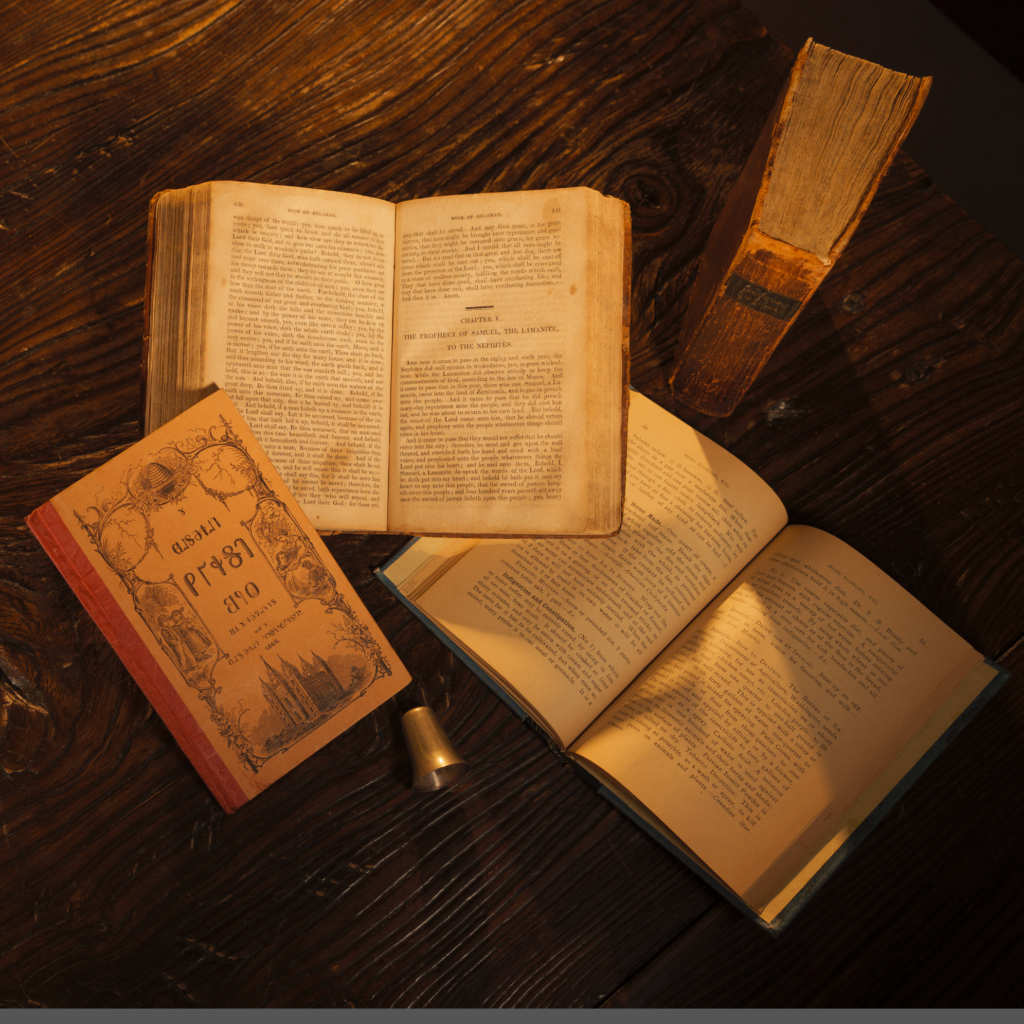
One of the “rockstars” of the Special Collections is a first-edition copy of The Book of Mormon. Considered by members of The Church of Jesus Christ of Latter-day Saints to be a volume of holy scripture comparable to the Bible, the first 5,000 copies of the religious text were published in 1830.
USU actually has two first-edition copies of The Book of Mormon in its collection, with the most popular one purportedly being — though not confirmed to be — David Whitmer’s personal copy. Whitmer was an early leader in the church and one of the Three Witnesses to the Book of Mormon.
“We have a lot of folks that come in and want to look at this [book],” Daybell says. “Students and their families come in, and we get a lot of traction during alumni events and different things.”
And while the copies of The Book of Mormon may be the most popular Latter-day Saint items in the collection, they are by no means the only ones — or even the most unique. The assemblage also includes a Deseret Alphabet Primary Reader, a book used to teach a phonetic alphabet championed by Brigham Young to simplify the English language and make it easier for both children and immigrant converts to learn, and a bank note from the Kirtland Bank.
Jack London Collection
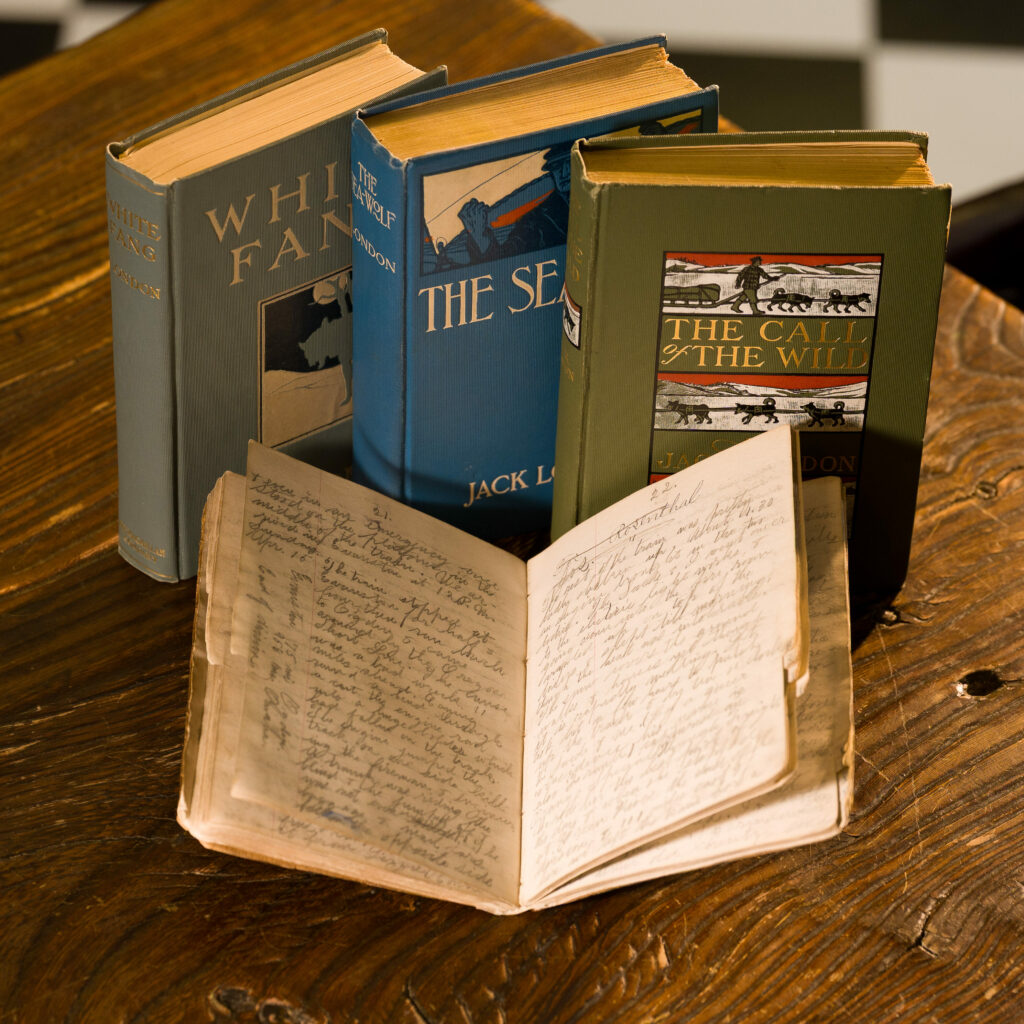
Best known for rugged tales of survival such as White Fang and Call of the Wild, Jack London was internationally famous by the age of 30 and one of the first American authors to earn a fortune from his work.
From expeditions to the gold rush in Alaska to traveling the world on his custom-built sailing ship, the Snark, London lived a life that matched the adventure in his stories. And, thanks to one of the world’s largest archival collections of his work — housed here at USU — readers can get a glimpse into that world.
“The collection really pulls together his evolving perspective of the world, all written through his scrawling script in letters to those closest to him and in inscriptions to Charmian (his second wife) in the book covers,” Woolcott says. “There is nothing like seeing it unfiltered, directly written in his own hand.”
The Jack London Collection, which began in 1964 and has been largely digitized, features a complete set of signed first-edition novels, as well as boxes of correspondence, journal entries and other manuscript items.
From handwritten drafts and publication proofs to his travels in the Yukon and South Pacific to his views on socialism, these materials provide a peek into London’s life beyond the page.
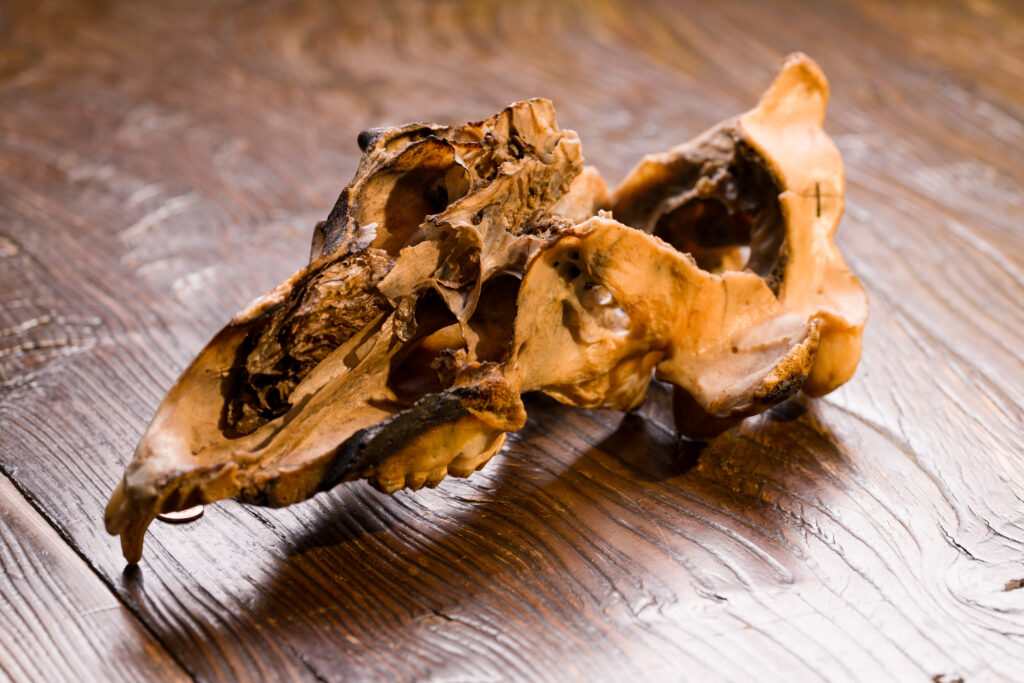
Old Ephraim’s Skull

For those Aggies who grew up in Cache County and the surrounding area, the tale of Old Ephraim is the stuff of legend. Told around campfires throughout Northern Utah and Southeastern Idaho, the story of the grizzly bear has grown even larger than the massive animal was rumored to be.
The bane of livestock owners in the early 1900s, particularly sheepherder Frank Clark who reportedly lost more than 100 sheep in a single season to the bear, Old Ephraim was finally killed in August 1923. Clark, who had spent more than a decade unsuccessfully attempting to trap the animal, was awakened in the middle of the night by a deafening roar near his camp.
He grabbed his .25-35 Winchester rifle and, with his dog in tow, found the bear ensnared in a heavy trap chained to a log. Despite that, the bear — also known as “Old Three Toes” due to a deformity on one of his front feet — charged Clark, who fired multiple times. Ultimately, the seventh and final shot pierced the skull and stopped the bear.
Originally burned and buried, that skull — after spending some time at the Smithsonian in Washington, D.C. — is now on display in the university’s Special Collections & Archives. Analysis suggests Old Ephraim was likely closer to 7 feet, 6½inches tall and 550 pounds, rather than the 10-foot-tall, 1,100-pound legend he’s morphed into.
“The legend of Old Ephraim is a perfect example of the stories that bind our communities together,” Daybell says. “Old Ephraim is our number one most-visited item and the unofficial mascot of Special Collections. Every community member has their own version of the story, and we are proud to honor the old bear’s legacy by offering resources of both his gargantuan legend and the more nuanced history of his story.”